 DU
DU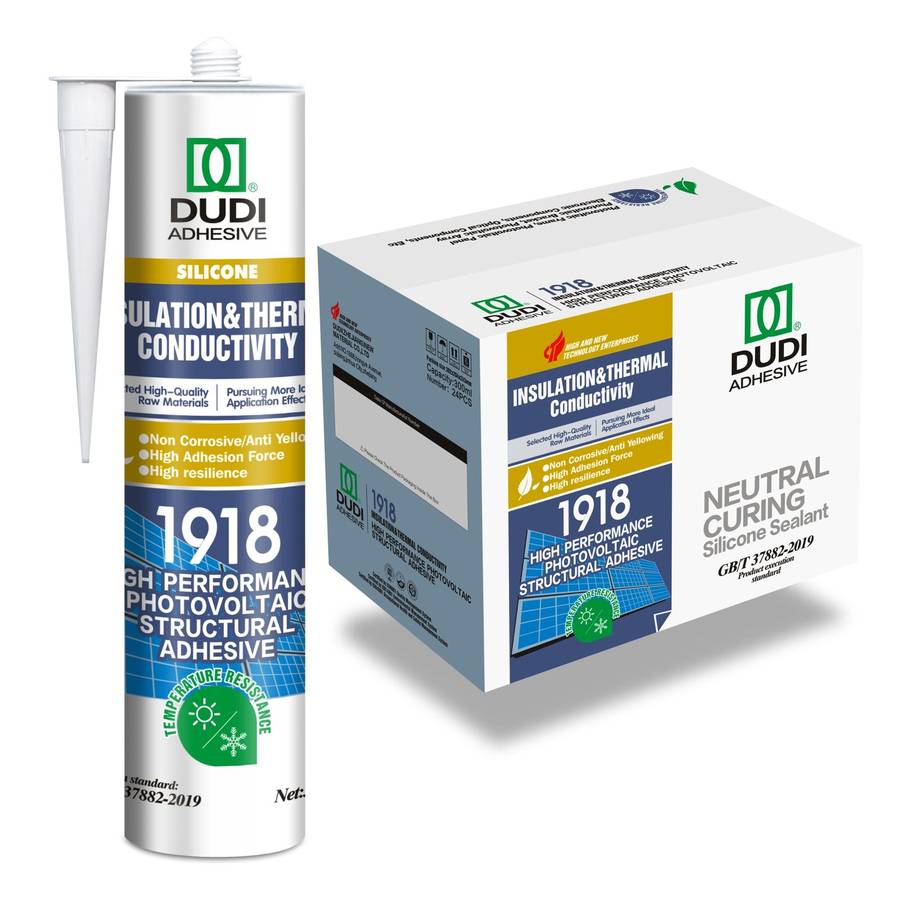
A photovoltaic module is asked to survive for more than 25 years of ultraviolet bombardment, daily thermal cycling and driving rain. The encapsulant and the sealant are what stand between the cells and that environment. Here is what buyers and module assemblers should demand from a PV sealant — and how to verify it.
The Environment a PV Sealant Must Survive
Installed modules see everything a sealant chemistry fears most:
- Continuous UV exposure — degrades organic polymer chains that are not UV-stable
- Thermal cycling — desert and rooftop installations swing from cold nights to cell temperatures far above ambient every day
- Humidity and water immersion — edge sealing and junction areas see standing moisture
- Galvanic contact — aluminium frames, tin-coated ribbons and glass edge surfaces in permanent contact
A sealant that passes a laboratory bench test can still fail in year three if any of these factors were ignored in its formulation. That is why type-test standards simulate all four.
What to Demand from a PV Sealant Supplier
For module sealing and structural bonding, ask for type-test evidence against GB/T 29595-2013 (silicone rubber sealants for ground PV modules) or the equivalent EN/IEC requirements your market references. The test battery covers the failures that actually happen in the field: adhesion loss after water immersion, cracking after cold-heat cycling, and degradation after UV exposure.
Reading a PV Sealant TDS: A Real Example
Our DUDI 1949 photovoltaic module sealant was independently type-tested to GB/T 29595-2013 (report 2024ME0608). The numbers show what a conforming grade looks like:
| Property | Requirement | Result |
|---|---|---|
| Appearance | Fine, uniform paste | Conforms |
| Sag (vertical) | ≤ 3 mm | 0 |
| Tack-free time | ≤ 3 h | 0.15 h |
| Elastic recovery | ≥ 80% | 98% |
| Tensile modulus at 23°C | > 0.4 or > 0.6 MPa | 1.53 MPa |
| Adhesion after immersion, cold-heat and UV | No failure | No failure |
The adhesion-after-conditioning row is the one that predicts field survival: no failure under every conditioning path, on the reference glass and anodized aluminium substrates.
Single-Component vs Two-Component for Your Line
Single-component grades (such as DUDI 1949) suit manual and semi-automatic application with no mixing equipment. Two-component systems suit high-speed automated lines with precise mix ratios, and potting grades (such as DUDI 1900) handle junction box and component encapsulation. For structural bonding of module frames, DUDI 1918 delivers 1MG-class structural performance tested to GB 16776-2005. Match the packaging system to your production process first, then verify the chemistry.
All three grades are manufactured at our Jinhua base and are available with English technical documentation for export projects.